2026-01-05: The wifi situation is more complex than I thought, I got two days of connection to 5GHz. At the same time I got acceptable battery life. I also learned about the spoofing feature of Aurora Store, and the Deutsche Bank app is now available. The outlook is already significantly brighter than described here.
tl;dr: The FLX1s delivers what I expected, and in some ways exceeds my expectations, but it misses on important things I was hoping would work out of the box. In particular, each Android app is a gamble, and I lost too many spins of the wheel. Beyond that, there’s an important bug that means wifi doesn’t work for me, and battery life is disappointing. Right now I can’t use this as my main phone. I’m hoping that some fixes will arrive in the next few months, and I will find workarounds for missing apps, so that I will be able to use this as my main phone before long.
Background
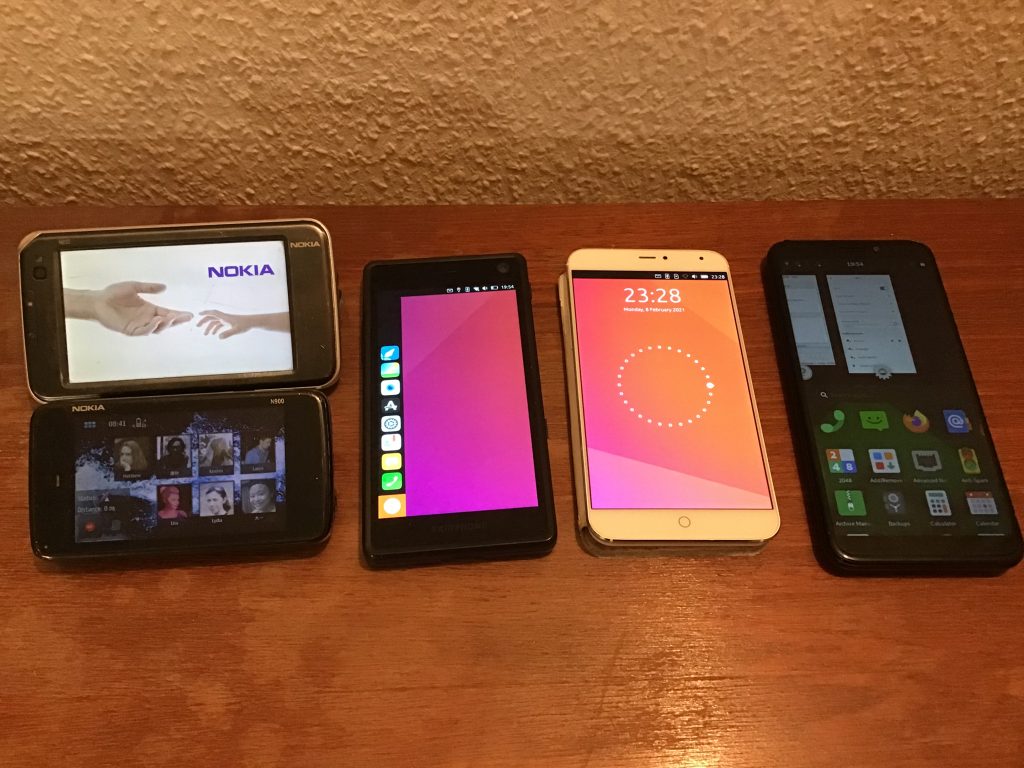
I’ve used several “nerd phones” in the past: I have a Nokia N810 (not a phone), two Nokia N900s (the USB port fell out of both of them), a Meizu MX4 Pro with Ubuntu Touch, a Fairphone 2 originally running their de-Googled Android but now running UBports, and a Pinephone running Manjaro. I was motivated to make these phones work for me for the same reason I originally installed Linux: open source gives me more control over and trust in a device that is a huge part of my life. But for the past decade or so I gave up on the dream and used iPhones – latterly a second generation iPhone SE. Since the app duopoly rose to power and made the N900 redundant, none of the Linux phones I’ve tried have been practically usable as a phone.
In my case WeChat has always been the highest hurdle to overcome. It’s non-negotiable for one set of my friends, but Tencent has zero tolerance for nonconformist technology. I have sympathy with the view that morality sometimes demands forsaking certain products, even if that’s inconvenient, even if it alienates your friends. I made the decision to delete my Facebook account and have nothing more to do with that company, so no more WhatsApp either. That cost me a large part of my social connections, and I still feel something missing to this day. But at least there are alternatives if people really want to connect with me. WeChat is different. Losing WeChat would cut me off from China. For me, that’s a defining part of my life, that I made connections in a part of the world that many of my peers find proverbially alien. That’s far more important to me than my phone operating system.
It’s not just WeChat though, that’s merely the most outstanding example. A phone is a communications device. That means its required capabilities are defined by the devices chosen by the people you want to talk to. It’s important to let go of the notion that individuals have consumer choice when it comes to phones. They do not. You do not. If the fight is between giant corporations in bed with corrupt governments versus one person at a time choosing a phone, it’s no fight at all. We will all drag each other back towards the path of least resistance sooner or later. In practice for me, none of the phones I’ve tried (except the Fairphone) could run Android apps. I despise Android, but until we get coordinated democratic action to break the duopoly, I still need to talk to my friends. That means either iOS or Android. I chose iOS.
In the meantime, the Waydroid project started to gain traction. This is exactly what I was hoping would happen, a compatibility layer allowing Android apps to run in a container. In principle this would give me a base of trustworthy software, but provide a way to do “everything else” that a phone should do as well. And the sandboxing should be, or at least could be, strong enough to prevent those apps doing all the exploitative and underhanded things for which Android apps are infamous. However, my experiments with Waydroid on a computer and on a Pinephone were pretty disastrous. Waydroid is too complex to get working as an individual. I wasn’t willing to invest in a phone without some pretty deep support from the phone maker themselves.
FuriLabs
This is where FuriLabs came in. I first heard about them in this article, and it immediately hit all the points I was looking out for. They are a company building real hardware, not just installing software on someone else’s device. Mind you, they’re tiny, which means they’re using whitelabel manufacturers in the background. However, they are joined at the hip to particular models of phone. If I buy something and it doesn’t work they’re not gonna just shrug their shoulders. And they are committed to supporting Waydroid, or rather their own fork of Waydroid called Andromeda.
For a particular model of phone, there are three features I was looking out for:
- Waterproof including immersion – salient since I dropped an N900 into a toilet in Krygyzstan that one time
- Wireless charging – because my N900s taught me not to trust physical ports
- Video output – because I have long dreamed of using a phone as a laptop replacement when travelling
The FLX1 had two out of three of those, and some kind of workaround for the third was promised. So, I was all out of excuses. I finally made an order in February 2025. My expectations were not high, but my hopes were, as I summarised in a tweet:

Bottom line: I rolled a 6.
Trump
Then came Liberation Day.
The communications from FuriLabs that I’ve seen have been careful not to criticise, or even mention, Donald Trump, and in the present climate I fully support circumspection. But, that guy sure did fuck things up. The ever-changing tariffs meant a grand restructuring of priorities for the electronics industry. In particular, large companies have mechanisms to work around the tariffs (such as, for example, bribing senior US officials) that are not open to smaller companies like FuriLabs. What we’re told is that some components being used in the FLX1 were no longer being produced at all. As a result, the whole phone could no longer be manufactured. Not just delayed – shut down. The details are confidential, but I really think some economist somewhere could write a pretty well-cited paper using this as a case study on the complex and unpredictable effects of tariffs in a modern economy.
The response from FuriLabs can only be described as audacious. In May they let it be known that they were planning to make a “sister device” to the FLX1, to be delivered as a substitute. In September they announced that the FLX1s would complete production in October. They later promised delivery to start in November, and while that did slip to December, it did not slip further. These timelines are absurd. There is an implication that they had been working on the FLX1s before May, but we’re still talking some kind of frenzied development process. I have to assume that the FuriLabs team have been driving themselves far beyond the limit the whole of 2025 to make this happen.
FLX1s
So I had my FLX1s in my hand on December 31, just making it across the line to say it went from conception to deployment inside a single year.
Along the way, many things got dropped. Several of those were serious blows for me. Of my original three must-haves, two disappeared. It is not waterproof but “life-proof”, which means I will still be nervous carrying the phone around water. Wireless charging went away. And video output is still out of reach. In fact the USB port is only USB 2 instead of USB 3, much slower than I expected. It also loses the replaceable battery, NFC, fingerprint reader, and headphone jack. That’s a lot less phone.
It gains some things. RAM increases from 6GB to 8GB – although it’s hard to predict how important that is unless you’re using it. It gains three physical privacy switches, a popular feature which I’m inclined to say is superstitious nonsense. Most significant for me is that it is much smaller than the FLX1. That’s very welcome. In fact I was worried the FLX1 might be too big to comfortably carry.
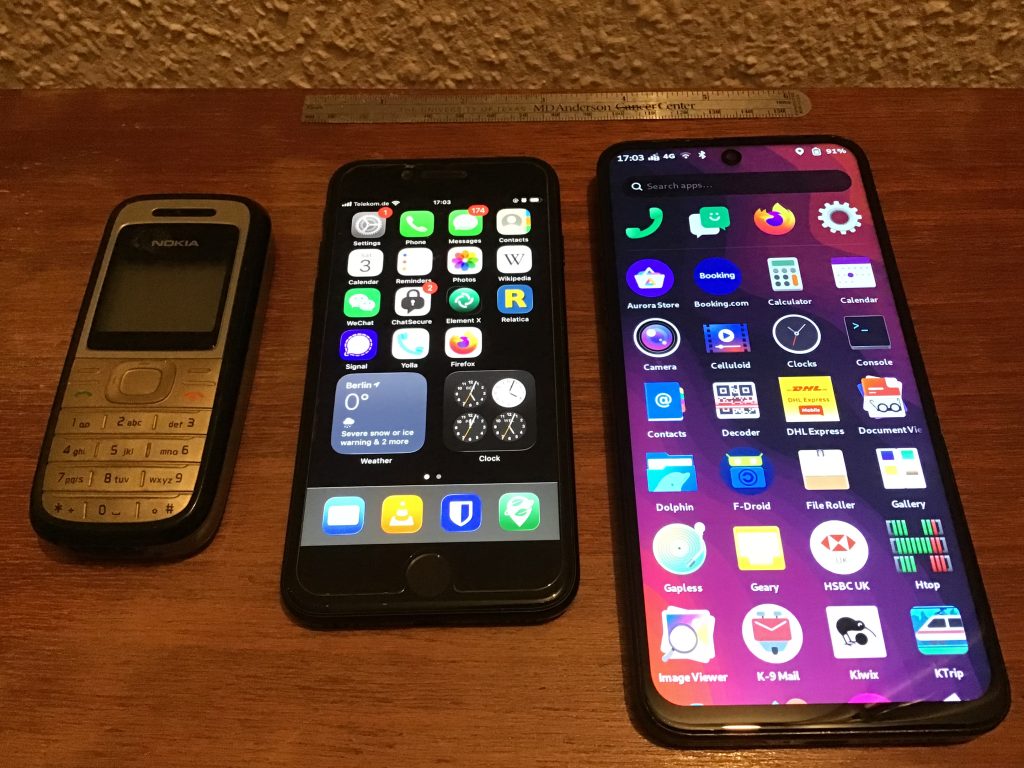
But really, none of that matters. Phone hardware hasn’t been important for years now, with big manufacturers either resorting to silly gimmicks like folding phones, or in the case of Apple just plain giving up. The promise from FuriLabs was not any particular hardware feature. Rather the promise was that 90% of your mobile life can be spent in truly open-source software, while still being able to rely on Android for the remaining 10%. The key is the reliability, which in the mobile phone world is only achievable if you are able to control both the hardware and the software. That’s why FuriLabs is the only company able to deliver a phone acceptable for my needs. As such, they can choose whatever hardware they like. I have no other choices.
Reality
So how did it go, once I had the phone in my hands?
The first impression is that this is a smooth phone. I’m used to using Phosh on the horribly underpowered Pinephone, so clearly I’m set up with extremely low expectations. Even so, the FLX1s feels faster than my iPhone. The UI moves more quickly, possibly because it’s been tuned for a slightly quicker set of users. It also, however, stutters occasionally, which spoils the effect a little. Native and Android apps start quickly, the latter faster than the equivalents on my iPhone SE.
The setup process is not bad at all. At least, Apple’s process is worse, and I assume typical Android setup is worse still. That’s because the large companies insist on registering personal details and accounts, which means passwords and confirmation codes. FuriLabs doesn’t need any of that, so you can get up and running more quickly.
I did run into problems when I tried to update to the latest software. It ultimately turned out that I’d hit my first major problem: 5GHz wifi doesn’t work reliably, so it’s constrained to 2.4GHz. And in my neighbourhood there’s so much 2.4GHz interference that this is essentially unusable. I struggled with installing software before eventually figuring out that this was the problem. In fact this prompted me to take a detailed look at how my 2.4GHz network performs:
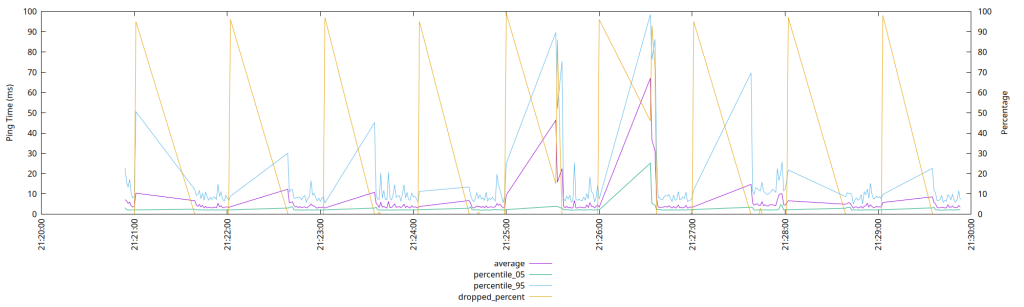
Uh… WTF? Something is blacking out the whole network, every single minute, on the minute, for 30 seconds at a time. I have no idea how this phone was able to achieve anything at all under those circumstances. It’s just incredible.
2025-01-05 I just got two days of apparently continuous connection to 5GHz wifi. Then when I rebooted it was back to 2.4GHz. In fact, looking again at the ping data I captured, I did get one stretch that very much looks like good 5GHz wifi for a few minutes. The issue isn't that 5GHz wifi doesn't work, it's that it will continuously work for days, then continuously stop working for days. It's complicated, but less dire than I first thought.
So I fought through the network issues to tackle the main event: how does the Android layer perform? I enabled Andromeda and microG. I used the pre-installed F-Droid to install the Aurora store, and then went wild. How did I do?
Apps
The first thing I tried was WeChat. Might as well face the music. And… it works! In particular, WeChat required me to scan a QR code from my iPhone in order to log in. This was something I was scared of: would the FLX1s make its camera available to Android apps smoothly? Yep, it sure did. Scanning QR codes is an essential part of using WeChat for other features such as payments. I do plan to visit China soon, which is simply not navigable without WeChat, and now I have confidence that this should be fine with the new phone. This one app is an enormous step forward over everything else I’ve tried.
2025-01-05 After writing this article someone mentioned that you need to spoof the device model number to install some banking apps. And it's true! I chose Google Pixel 9a, and the Deutsche Bank app now works fine. I still haven't figured out my photoTAN situation, but it seems I'm being treated like any other Android user.
But that was the high point. As I mentioned in my tweet, the other expected barrier was Deutsche Bank. And that ran straight into the Android “Safety Net”.
To clarify with unnecessary detail, until now I’ve had three irritatingly-separated Deutsche Bank apps. The main app lets me see my account. A second app lets me activate my card. And a third app is the “photoTAN” app, which scans Deutsche Bank’s off-brand not-QR-codes for authentication purposes. It’s that last one that matters. I can do anything on the website, but I can’t log in without scanning a code with the app. It’s completely stupid that they have three different apps for these things, and since I ordered my phone they’ve recognised that by unifying them and deprecating the photoTAN app. Although I can continue using the photoTAN app on my iPhone, they no longer allow enrolling new devices. You need to use the main app. The Android photoTAN app actually installs on the FLX1s no problem – but now you can’t use it. The main app does not install: “this app is not available”.
Again, this is no shock at all. It was made very clear to me that banking apps in particular often require a hardware and software stack fully approved by Google before they will run. Some banking apps work, some don’t. And even though I asked, there was no way to check the status of Deutsche Bank without buying the phone and trying it. You can gain hints by looking at the experience of GrapheneOS users, but that’s a very different system and no guarantee of what will happen on the FLX1s. I took the gamble, and I lost.
This is pretty bad. Without my iPhone to help me log in I can’t even use the website with my computer. However, I’m sure that Deutsche Bank must provide some mechanism for authenticating beyond mobile phones. Many Germans, even developers I work with, choose not to have a smartphone at all. It’s just a question of talking to Deutsche Bank about my options. But on the other hand: I have to talk to Deutsche Bank 😱 That hurts.
2025-01-05 With device spoofing, the Deutsche Bank app installs and works. The BVG journey planner app installs, and lets me buy tickets, but refuses to plan a journey without Google Play. To get the Post & DHL app I had to switch the language to German, but it looks like that works. I haven't got MeinMagenta working yet. So this is looking much more optimistic than it did a few days ago.
So I’m disappointed. But that wasn’t the only app that failed. Here’s a list of apps I can’t use:
- Deutsche Bank
- BVG, public transport monopoly in Berlin
- DHL, used to collect parcels from drop-off points
- MeinMagenta, app for T-Mobile/Deutsche Telekom, the provider of both my mobile and fixed telephone connection
That’s a grim list. Those are four critically important apps for my day-to-day life in Berlin.
What’s more, there are some common factors there that are strong warning signs for the future. All of those are big companies, but not big-tech big. None of them are really worried about competition. At least, none of them are worried that you will switch to a competitor because you don’t like their app. So while a genuine technology company might prioritise their app and work to ensure maximum compatibility, none of these companies have to. Since they don’t have to, they can’t. They don’t have the budget to spend on something that won’t noticeably affect the bottom line. Meanwhile, none of these apps are in the top ten of anything. So there’s precious little incentive to the platforms to bend over backwards to make them work. That’s true whether we’re talking about Apple and Google or FuriLabs.
As I travel around the world I can expect to bump into this kind of thing over and over again, from local public transport and phone companies as well as other essential service providers. I think I will probably find work-arounds for all of these at some point. But right now, if I hear that in order to complete some chore I “just need to download the app”, that’s going to trigger a fear response. That’s exactly what I didn’t want.
Surprisingly, the HSBC UK app works fine. For some reason even though it scanned the QR code from my iPhone it wouldn’t successfully authenticate that way, but it did let me log in using the camera to scan my passport and take a selfie. I suspect this app has relatively loose security because it’s just a web view, not a real app that stores data locally. But it also provides authentication, so perhaps they just don’t care. Signal works fine. Organic Maps works well, proving that GPS works for Android apps without fuss. The BitWarden app refuses to install, so I’m using the Firefox plugin instead.
Some of the failures I’ve experienced aren’t just apps refusing to install at all, but rather that logging in doesn’t work. These could be due to the network issues I found. But I tried most of these again using an ethernet adapter and they still failed, so I don’t think that’s the issue. And of course some of these problems might be due to release-day bugs and be fixed over the next few months. I hope so. But for today, this is definitely enough for me to rule out switching to the FLX1s immediately. I still need to carry my iPhone.
Battery Life
2025-01-05 I performed another test with the same setup, but this time recorded 31 hours. That's much more acceptable. It's still short of what other people report. What I noticed though, was that this test was running during a stretch when 5GHz wifi was working. My new theory is that the problems on my 2.4GHz network that I reported above are causing the phone to burn energy trying to find a network, every minute. It's going to be difficult to prove that. But one way or another, good battery life is definitely achievable.
More bad news on battery life I’m afraid. I found that after switching off Andromeda, and leaving the phone sitting almost undisturbed with the screen off, it went from 100% to dead in 19 hours. That’s really a lot less than I would have expected.
It also doesn’t match reports from other users. It is very likely that some of the things I installed are preventing the phone from sleeping properly. Certainly when I installed Signal it popped up a notice that it would keep a socket open to the server and that might well impact battery life. That’s why I switched off Andromeda for my test, assuming that this would kill Signal’s background processes. I also have the native Chatty app connected to both XMPP and Matrix, which might be doing the same thing without the warning. Finally, I installed openssh-server, which may also be running a process that prevents sleeping.
Those might be fixable, but the real problem here is that there are so many ways to kill battery life (and probably also the unswappable battery itself!) without realising what you’re doing. The iPhone has a very detailed and intuitive battery screen that breaks down usage by app, including telling you how much time you spend with the screen on for each. For a Linux phone, you can only figure out the problem by tedious and unscientific trial and error. That’s probably an architectural problem with the Linux stack that cannot be solved. And with so many booby traps lying around, especially from half-formed suggestions on forums, this is a huge problem for wide adoption.
For myself, I guess that as I watch suggestions on the FuriLabs forums and the Matrix channel, I will eventually happen across the tips I need to get a decent battery life out of this phone. But again, this is enough for me to rule out switching to the FLX1s immediately.
Really, there’s no reason for me to switch away from the iPhone unless Apple completely fucks up.
How To Completely Fuck Up
The big problem for me is the dreaded news that some essential service can be easily completed/bypassed/expedited by just installing our convenient app, available on both Apple and Google App Stores simply scan this QR code. I was hoping that the FLX1s in my pocket would allow me to stay calm in those situations, instead of panicking as I do now.
Why would I panic when I have a completely legitimate and norm-conformant iPhone in my pocket?
I live in Berlin, but I generally spend a month or so in Australia each year to visit my family – and props to my employer for allowing me to work remotely during that time! In Australia I am living in Australia. I have a bank and a phone company and I use the local public transport monopoly, just as in Berlin I use the German equivalents. And many of those apps are only available in one country’s app store.
I really just… no I don’t get it. I mean, if you were stupid, sure. You can only take a Transperth bus if you’re in Perth, right? So why would someone who lives in Germany need the Transperth app? If you never considered the possibility that there might be tourists, you might think that. I guess? And my Australian bank, ANZ, also… nope, again, I’m at a loss. Why would you do this to yourself?
So in practice, I need two different Apple IDs, one for Germany and one for Australia. Today, thankfully, Apple allows me to switch between Apple IDs without major punishment. I mean, it does switch on iCloud synchronisation every single time I do that despite me stubbornly switching it off everywhere. That’s much less than they could do, or probably will do in the future. But that’s not the problem.
The problem is that each Apple ID is associated with a phone number. I can’t switch to my Australian Apple ID until I receive an SMS. But I get a new Australian phone number every year. It doesn’t make sense to pay a monthly fee when I’m only there one month in a year. This means every time I land in Perth I have “lost” my phone number. I need to go through Apple’s account recovery process, which takes about a week. During that week I’m not allowed to update the Transperth app or the ANZ app. And since they invariably have released a compulsory update in the year I was away, that means I can’t use either app at all.
I visited 11 countries in 2025. Increasingly, they all assume you can install an app for any number of tiny but essential purposes. That’s why I panic. So far I haven’t visited a city idiotic enough to make public transport from their airport possible only by downloading an app exclusively available in their country’s app store. But I’ve run into enough problems almost as absurd that I’m sure it’s only a matter of time.
It all makes me dream of a phone that allows me to “side load” (a hateful term) the necessary package, forcing it in there by whatever means necessary. It’s my phone, I know better than this infernal operating system. Sometimes I just don’t care about my safety and security as they concern my digital life, rather I want to get the fuck out of this poorly-lit parking lot because it’s two o’clock in the morning and I’m terrified.
That’s not the only reason I’m sick of Apple. I think of the constant need to upgrade operating systems full of unwanted misfeatures that just move everything around for no reason. I think of the forced obsolescence, my perfectly good Macbook sitting over there in the cupboard just because Apple didn’t want to support it any more. For complex reasons I read my news in email, but inbox synchronisation has never worked properly so it doesn’t work on planes. And this new liquid glass thing is just an insult. These are the daily pokes in the eye that I endure from Apple. Every single time, I can hear a board of corporate executives congratulating each other on the exceptionally low churn rates they’ve been able to achieve through their exacting customer research.
I want out so, so badly. I believe in open source, I believe in restoring meaningful competition, I believe in repairability and sustainability, I believe in privacy and security. None of those would convince me to drop USD500 on a phone that I know is going to lead only to months of hacking. It takes years of concentrated effort by Apple to make that happen.
2025-01-05 At this point there seem to be no major blockers to this becoming my new primary phone, just lot of irritations and workarounds. I expect it'll take me a few weeks to get the phone set up comfortably before I switch.
Today there are three obstacles each serious enough on their own to prevent me using this phone: wifi, app compatibility, battery life. So my primary phone number will stay in my iPhone for the next few months. But every day Apple will jab me in the ribs to remind me to pick up the FLX1s sitting right there. One day, not far off, I won’t put it down again.
Watch This Space
So that was a pretty negative assessment. But that shouldn’t be any discouragement. FuriLabs’ CEO made it clear that it was a conscious decision to get this phone into the hands of real users as early as possible, without waiting for every last issue to be ironed out – and they proved that “possible” is far earlier than I could have guessed. They released as soon as the hardware was confirmed good, not waiting until the software was perfect. I know the team have been working exceptionally hard to polish the software anyway, that’s partly why my hopes were quite high. But even for bigger projects it’s normal for the first few months after release to be exciting times.
I’m pretty confident that this assessment won’t be the last word on my experience with this phone. I intend to update this article with additional notes as developments unfold. And I welcome corrections. On the other hand, if I kicked your puppy, well, it was under my feet.
4 thoughts on “New Phone”
For Signal, you might want to try Flare for a native Linux thing. It works well on phones.
Thanks for the suggestion! I tried Flare, but it constantly crashed while trying to link to the Signal account. Linking the account is crazy complicated: it shows a QR code, which I have to photograph with a second phone, so that I can display it, switch to the Signal app, then scan that code to link the device, then switch back to Flare to confirm, all within a one minute timeout! I tried several times but Flare always crashed somewhere in the process.
Hi, Matthew, thanks for your post.
In contrast to you I am a total newbie to Linux on mobile phones. Same as you I received my FLX1s recently. 5G did not work for me at all, 2.4G did and I managed to update my phone, but only after the inital setup. My FLX1s at least thinks, it’s up to date.
Would you mind giving me some hints on how to progress getting my feet wet configurationwise? I intend to use my Android phone and the FLX1s in parallel for some time and switch gradually.
I’ve certainly been struggling myself getting things working. My best recommendation is to keep an eye on https://furilabs.com/forum/. In my experience with Linux phones, whatever it is you’re trying to do, you won’t make much progress. If you have time to spend, focus on the things you can get working rather than the things you can’t. The forum is the best place I’ve seen for that. The Matrix chat is busy, but too disorganised. An example, I only just figured